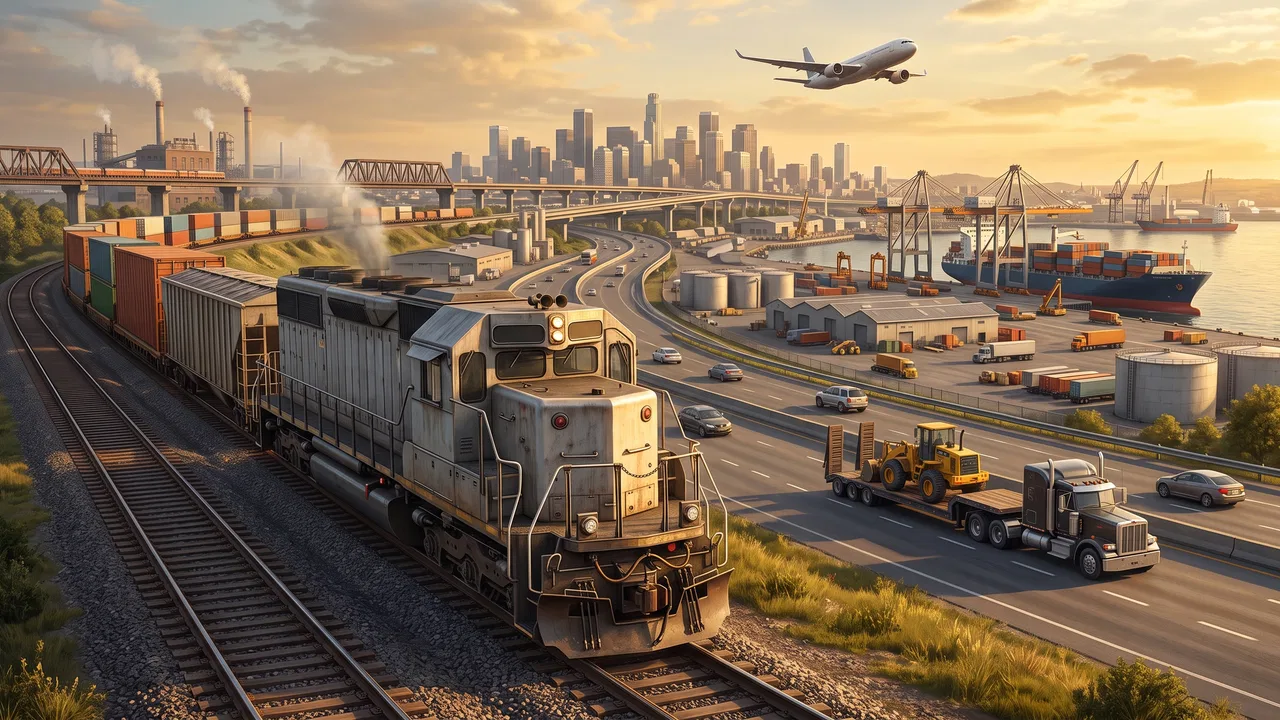
Transport Tycoon Empire 2
- 4.6
- Rating
- 50.00K
- Installs
- Free
- Price

 Analysis by App-foxy
I approached Transport Tycoon Empire 2 as a decision rather than simply another game to fill a few spare minutes. It is a free strategy game from Alda Games, built around the idea of growing a transport business across different periods. That premise immediately puts it in an interesting space: it is more thoughtful than a quick arcade title, but it is also designed to be approachable on a phone rather than demanding the depth of a traditional desktop management simulator.
My first impression was that its appeal depends less on spectacular presentation and more on whether you enjoy making connected choices. You are not just moving vehicles from one point to another. You are trying to make a transport network work as a whole, deciding what deserves attention first and accepting that improving one part can expose a weakness somewhere else. For me, that makes each session feel like a small planning exercise rather than a simple sequence of upgrades.
The game is currently free to download, carries an Everyone age rating, and runs on devices using Android 7.1 or later. Its current version is 0.8.4, and the store shows a 4.6 average from around 4.2 thousand ratings, with more than 50 thousand installs. Those figures suggest a healthy early audience, but I would still treat the game as something to evaluate on its own terms: the right question is whether its transport-focused decision-making matches the way you like to play.
You May Also Like

 Pandora - Music & Podcasts
Pandora’s Music Is Easy to Start, but Harder to Recover
Pandora’s strength is its low-effort path from a seed to a station. Its weak spot is how much confidence it asks you to place in connection, setup, and quiet recovery.

 AccuWeather: Weather Radar
AccuWeather Review: A Quick, Clear Forecast for Everyday Decisions
For everyday plans, the best forecast is the one you can understand quickly. AccuWeather makes rain timing, radar, and local conditions easy to act on, with a few trade-offs.

 Hill Climb Racing
Why Hill Climb Racing Still Turns Crashes Into One More Run
A tiny car, a bumpy hill and one more upgrade: Hill Climb Racing keeps resurfacing because its simple chaos makes every near-miss feel personal.

 AliExpress - Shopping App
AliExpress Makes Global Shopping Feel Personal, but Shoppers Bear the Risk
AliExpress turns a global marketplace into a pocket-sized discovery engine. Its reach is useful, its shopping loop compelling, and its trade-offs easy to miss.

 Lords Mobile: Kingdom Wars
Lords Mobile Is a Kingdom-Building Routine, Not a Quick Match
A case-by-case verdict on the building, battles, device demands, and social commitments that make Lords Mobile rewarding for some players and exhausting for others.

 PDF Scanner app - TapScanner
TapScanner Makes Paperwork Easier to Capture, Check, and Share
TapScanner makes scanning with a phone feel less like a rescue operation and more like a dependable step in getting work done. Its capture tools are useful, though not flawless.
More From Our News Desk
View All News


What to judge before committing to a transport strategy game
The most important decision criterion is how much planning you want between actions. Some mobile strategy games reward rapid tapping, short missions, or collecting rewards whenever they appear. This one is better suited to players who like looking at a network, spotting an inefficient connection, and thinking about the next improvement before spending resources. If that sounds satisfying, its central idea has real potential. If you want immediate action with little reading or organisation, the transport theme may feel slower than expected.
I also paid attention to how well the game works in ordinary situations. A transport manager is easy to enjoy during a long uninterrupted session, but mobile players often open a game while waiting for an appointment, riding public transport, or taking a short break. The useful test is whether a brief visit still feels meaningful. In my experience, the game works best when I begin with a clear task, such as improving one connection or preparing the next expansion, rather than opening it without a plan and expecting instant excitement.
Another criterion is tolerance for gradual progress. Building an empire through several decades naturally suggests a long-term rhythm. The satisfaction comes from seeing a modest operation become more capable, not from finishing everything immediately. That makes patience valuable. Players who enjoy watching a system develop over time will understand the appeal quickly, while anyone who dislikes waiting, repeating management steps, or making incremental improvements may find the pace frustrating.
I would also consider how comfortable you are with economic trade-offs. A good transport decision is rarely only about choosing the most impressive vehicle or the biggest route. It is about whether the investment improves the network enough to justify its cost and attention. That kind of thinking is the heart of the experience, and it is also where the game can become mentally demanding on a small screen.
How the core loop feels in everyday play
My preferred way to play is to start by identifying the part of the network that is causing the most trouble. Instead of upgrading whatever is available, I look for a bottleneck: a route that does not support the rest of the operation, a link that needs better capacity, or an area that is not contributing enough to justify further attention. This approach makes the game feel more strategic and prevents the common mistake of spending resources simply because an upgrade button is visible.
A realistic example would be opening the game during a ten-minute coffee break. I would not try to redesign the entire empire. I would check the current flow, choose one weak connection, make a focused adjustment, and leave with a clear next objective. That routine suits the mobile format better than trying to micromanage everything at once. It also helps me remember why I made a particular decision when I return later.
One useful habit is to separate expansion from stabilisation. When a new opportunity appears, the tempting response is to grow immediately. I found it more sensible to make sure the existing network can support the next step first. A new route may look profitable in isolation, yet create extra pressure on the rest of the system if the surrounding links are not ready. This is one of the less obvious lessons of the game: growth is not automatically progress when the underlying network is unbalanced.
I also recommend keeping a mental priority list rather than reacting to every available prompt. The game is more enjoyable when I decide what matters before I start spending. My usual order is to protect the most important existing connection, improve a clear bottleneck, and only then consider a fresh expansion. It is a small change in approach, but it reduces waste and makes the empire feel shaped by deliberate choices instead of constant reaction.
Where this game stands out
The strongest part of the experience is its clear identity. Transport is not merely a decorative theme placed over a general strategy framework. The idea of connecting places, managing movement, and building an operation across changing eras gives the decisions a practical logic. I can understand why an upgrade matters because it belongs to a broader network, not because the game simply tells me that a number has increased.
That network perspective is also why the game can be more interesting than a standard construction title. In a typical builder, I may focus on placing structures and improving individual locations. Here, the relationship between locations matters just as much as the locations themselves. A strong part of the empire can be held back by a weak link, which encourages me to think in terms of flow rather than isolated buildings.
The historical progression adds another layer to the fantasy. Moving through decades makes the project feel like an ongoing enterprise rather than a single fixed map that never changes character. Even without treating the game as a serious history lesson, the time-based framing helps communicate that transport systems evolve and that yesterday’s solution may not remain the best answer forever.
I also like that the game can be enjoyed in two different ways. A relaxed player can treat it as a gradual empire-building experience, checking in and making sensible improvements. A more analytical player can look for inefficiencies and optimise the order of decisions. That flexibility is valuable because it gives the same transport theme different levels of intensity without requiring every session to become a spreadsheet exercise.
The game’s rating and growing install base make it easier to recommend as a title worth trying, but the real strength is more personal: it gives planning a concrete shape. I am not merely collecting abstract points. I am trying to make a connected operation function better. That context makes even a modest improvement feel earned.
Small decisions that make a large difference
The first non-obvious insight is that the best upgrade is often the one that removes a restriction elsewhere. I used to think in terms of improving the weakest individual asset. A better approach is to ask which change will help several parts of the network at once. A connection that supports multiple routes can be more valuable than a flashy improvement that benefits only one isolated segment.
The second is to avoid judging a route by its immediate appeal. A new connection can look attractive because it promises growth, but its real value depends on what it feeds into and what depends on it later. Before committing, I consider whether the route strengthens the wider structure or simply adds another obligation to manage. This makes expansion slower, but it also makes the resulting network easier to control.
The third is to use short sessions for diagnosis and longer sessions for redesign. When I have only a few minutes, I inspect the network and decide what needs attention. When I have more time, I make the larger changes. Mixing those two modes can lead to rushed decisions, especially when I start rebuilding without a clear idea of the problem I am trying to solve.
A fourth useful trade-off concerns ambition. It is satisfying to pursue a large transport empire, but a smaller, well-organised network can be more rewarding than a sprawling one that constantly needs rescue. I would rather have a clear plan for several reliable connections than expand in every direction and lose track of what each part is supposed to accomplish.
Where alternatives may fit better
The usual alternatives in this category fall into different groups, and choosing between them depends on what you want from strategy. A city-building game may be better if your pleasure comes from zoning, architecture, and watching a settlement take shape. A classic tycoon simulator may suit you more if you want very detailed economic controls, dense menus, and a larger emphasis on precise financial management. A puzzle strategy game may be preferable if you want compact challenges with a definite solution rather than an evolving business.
This game wins when the transport network itself is the attraction. It offers a middle ground between a casual mobile builder and a highly technical management simulation. That middle ground is useful for players who want meaningful planning without committing to the complexity associated with a full desktop-style tycoon experience.
However, the same balance can be a weakness for specialists. If you already know that you want deep accounting, exhaustive customisation, or a huge number of systems interacting at once, you may prefer a more demanding alternative. I would not choose this title expecting it to replace every serious logistics simulator. Its value is in making transport management readable and portable, not in overwhelming the player with every possible variable.
It may also be the wrong choice for someone who mainly plays in very short bursts and wants constant rewards. The game’s best moments come from understanding how decisions connect. If you do not have the patience to observe a network and wait for your plan to develop, a faster strategy game will probably feel more satisfying.
On the other hand, players who find traditional tycoon games intimidating may appreciate the more approachable entry point here. I can recommend it to someone who likes the idea of logistics but does not want to begin with a dense manual. It teaches through the act of managing rather than demanding that the player already understand every economic principle.
What to expect from the free model
The game is free, which makes trying it straightforward, but it includes in-app purchases ranging from $0.99 to $199.99 per item. That wide range is important when deciding whether it belongs on your device. I would begin with the free experience and pay attention to whether the normal progression feels comfortable before considering any purchase. There is no reason to spend simply because an optional offer appears during a moment of impatience.
My practical advice is to treat purchases as a convenience question, not a requirement for understanding the game. If you enjoy the planning itself, rushing progress can remove part of the satisfaction. The better test is whether the free loop gives you enough room to make decisions, learn from mistakes, and build at your own pace. If it does, the game has already proved its value without asking for money.
The cost of switching from another strategy game is mostly a change in mindset. A player coming from a city builder may need to focus less on appearance and more on connections. Someone leaving a fast casual game may need to accept a slower rhythm. A player moving from a complex tycoon simulator may need to accept fewer layers of detail in exchange for easier access on a phone.
That transition is not difficult, but it is worth recognising. I would not carry over the habit of upgrading whatever is newest or most visible. In this game, a modest improvement to an existing network can be more useful than an impressive new direction. Giving yourself time to learn that principle is the main switching cost, and it pays off quickly once the network starts to make sense.
Who should install it, and who should skip it?
I would recommend it to players who enjoy logistics, gradual development, and decisions with consequences across a connected system. It is especially suitable for someone who wants a strategy game that can be checked during the day but still rewards careful thought. The Everyone rating also makes it an accessible choice for households looking for a less aggressive form of strategy, although the planning can still require concentration.
It is a good fit for fans of transport themes who want more than a decorative vehicle collection. The game gives the subject a practical purpose: routes, links, growth, and long-term organisation. It is also a sensible starting point for newcomers who are curious about tycoon games but do not want to begin with the most complicated option available.
I would skip it if your ideal game is built around immediate combat, rapid reflexes, or a short fixed campaign. I would also hesitate to recommend it to players who dislike free-to-play economies on principle, particularly because the individual purchase range reaches as high as $199.99. Even if you never buy anything, seeing purchase opportunities can affect how comfortable you feel with the overall experience.
Device compatibility is another simple checkpoint. Because the minimum requirement is Android 7.1, owners of older phones should check their operating system before planning around the game. For supported devices, the more important question is personal: do you want to manage a growing network, or would you rather build something visually or solve a self-contained puzzle?
My recommendation after weighing the trade-offs
After looking at its strengths, limits, and alternatives, I think this is a worthwhile recommendation for the right kind of strategy player. Alda Games has chosen a focused concept, and the transport setting gives the progression a useful sense of direction. I enjoy it most when I approach each session with one problem to solve instead of treating it as a checklist of rewards.
I would start slowly, resist unnecessary spending, and learn the network before attempting ambitious expansion. That approach reveals the game’s best quality: the feeling that a successful empire is the result of several sensible decisions working together. It also protects you from the most common frustration, which is growing faster than you can properly manage.
The final decision is simple. Choose this game if you want an approachable mobile strategy experience centred on transport connections and long-term planning. Choose a city builder if visual development matters more, a deeper tycoon simulator if you want maximum economic detail, or a faster casual title if you need instant action. For me, the balance is convincing enough to recommend trying the free version, with the clear understanding that its enjoyment comes from patient network management rather than constant excitement.
My verdict: install it when you want to think like a transport planner, not merely tap through another upgrade loop. The game is not the universal answer for strategy fans, but it has a clear audience and serves that audience well. Its strongest moments arrive when a route, a bottleneck, and a carefully timed improvement finally work together, turning a collection of separate decisions into a transport empire that feels genuinely yours.
FAQs for Transport Tycoon Empire 2
01What is Transport Tycoon Empire 2?
Transport Tycoon Empire 2 is a business and management game in which you build a transportation company from the ground up. You organize routes, deliver cargo, upgrade vehicles, expand your fleet, and develop a growing logistics network. The game combines city-building elements with tycoon-style strategy, so success depends on planning profitable connections rather than simply completing individual deliveries.
02Is Transport Tycoon Empire 2 free to download and play?
Yes, Transport Tycoon Empire 2 can generally be downloaded and played for free, but it includes optional in-app purchases. These purchases may provide premium currency, speed up construction or upgrades, and offer additional resources. Progress is possible without spending money, although free players may need more patience when waiting for timers, collecting materials, or competing with players who invest in premium features.
03Does the game require an internet connection?
An internet connection is normally required for the main Transport Tycoon Empire 2 experience. Online access allows the game to synchronize progress, load events, manage account data, and support connected features such as competitions or shared activities. Because of this, it is not the best choice for completely offline play. A stable connection is also recommended to avoid synchronization problems or lost progress.
04What can players do in Transport Tycoon Empire 2?
Players can construct and improve a transportation empire by purchasing vehicles, delivering different types of cargo, completing contracts, and connecting locations across the game world. As the company grows, you can expand routes, improve production and delivery efficiency, unlock new opportunities, and manage limited resources. The gameplay is focused on long-term development, with strategic decisions affecting how quickly and profitably your business expands.
05Is Transport Tycoon Empire 2 suitable for casual players?
Transport Tycoon Empire 2 is suitable for casual players who enjoy management games that can be played in short sessions. You can check deliveries, collect rewards, start upgrades, and arrange new tasks without needing to play continuously. However, players who dislike waiting systems, repeated resource collection, or optional purchases may find the progression slower than expected. It is best suited to fans of relaxed but strategic tycoon gameplay.
Pros
- Deep transport management with roads
- railways
- ships
- and aircraft
- Large variety of vehicles keeps fleet building interesting
- City contracts provide clear short-term goals and rewards
- Bright visuals make routes and vehicles easy to follow
- Regular events add extra challenges beyond the main progression
Cons
- Energy limits can interrupt longer play sessions
- Upgrading a large fleet requires considerable resources
- Some progress feels slow without frequent logins
- Menus may feel crowded for new management-game players
- Random rewards can make obtaining specific vehicles unpredictable

Transport Tycoon Empire 2
Gallery